
 RU
RU KZ
KZ EN
ENDisaster recovery
A planned capability to restore critical IT services after a major outage, cyber incident or site-level failure within defined recovery objectives.
Discuss a project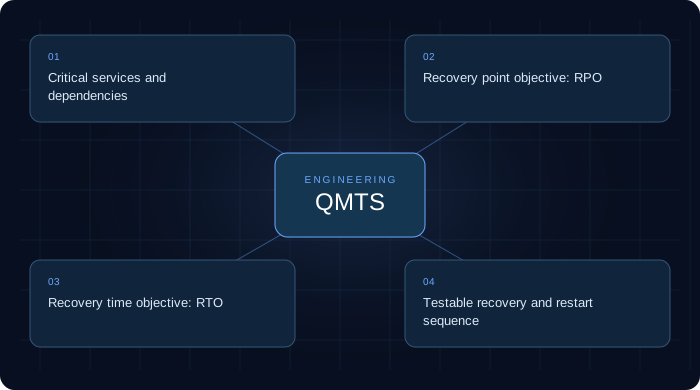
What it is
Disaster Recovery combines replicated or recoverable workloads, alternate infrastructure, runbooks and tested failover/failback procedures.
Why it matters
Backups protect data, while DR focuses on restoring service availability; the design should be driven by Recovery Time Objective (RTO) and Recovery Point Objective (RPO).
What shapes the design
- Critical services and dependencies
- Recovery point objective: RPO
- Recovery time objective: RTO
- Testable recovery and restart sequence
QMTS delivery scope
We identify critical workloads and dependencies, define RTO/RPO targets, design recovery architecture and runbooks, implement replication or recovery mechanisms and test recovery procedures.
Customer deliverables
A documented and testable recovery capability with defined priorities, RTO/RPO targets and operational procedures.
Typical use cases
Critical business applications, data-center environments, virtual infrastructure, ransomware resilience and business-continuity programs.
Delivery lifecycle
- 01 Requirements discovery and current-state assessment.
- 02 Architecture, dependencies and implementation planning.
- 03 Technical specification, configuration baseline and delivery preparation.
- 04 Implementation, integration, testing and controlled commissioning.
- 05 As-built documentation, operational handover and managed support where required.
Before we start
To scope a project, describe the goal, users and sites, current systems, timing constraints and desired outcome. Solution scope and service terms are defined after assessment.
Start with your challenge
Tell us what you need to build, connect or improve. An idea, a list of issues or a technical brief is enough to start.
Support coverage and SLA parameters are agreed for each project.
Discuss a project
Leave an email address or phone number so we can respond.